Fair Use Notice

FAIR USE NOTICE

A BEAR MARKET ECONOMICS BLOG

Follow Every Bear Market Economics blog post on Facebook here

This site may contain copyrighted material the use of which has not always been specifically authorized by the copyright owner. We are making such material available in an effort to advance understanding of environmental, political, human rights, economic, democracy, scientific, and social justice issues, etc. we believe this constitutes a ‘fair use’ of any such copyrighted material as provided for in section 107 of the US Copyright Law.

In accordance with Title 17 U.S.C. Section 107, the material on this site is distributed without profit to those who have expressed a prior interest in receiving the included information for research and educational purposes. For more information go to: http://www.law.cornell.edu/uscode/17/107.shtml

If you wish to use copyrighted material from this site for purposes of your own that go beyond ‘fair use’, you must obtain permission from the copyright owner.

FAIR USE NOTICE FAIR USE NOTICE: This page may contain copyrighted material the use of which has not been specifically authorized by the copyright owner. This website distributes this material without profit to those who have expressed a prior interest in receiving the included information for scientific, research and educational purposes. We believe this constitutes a fair use of any such copyrighted material as provided for in 17 U.S.C § 107.

Read more at: http://www.etupdates.com/fair-use-notice/#.UpzWQRL3l5M | ET. Updates
FAIR USE NOTICE FAIR USE NOTICE: This page may contain copyrighted material the use of which has not been specifically authorized by the copyright owner. This website distributes this material without profit to those who have expressed a prior interest in receiving the included information for scientific, research and educational purposes. We believe this constitutes a fair use of any such copyrighted material as provided for in 17 U.S.C § 107.

Read more at: http://www.etupdates.com/fair-use-notice/#.UpzWQRL3l5M | ET. Updates

All Blogs licensed under Creative Commons Attribution 3.0


Sunday, May 22, 2016

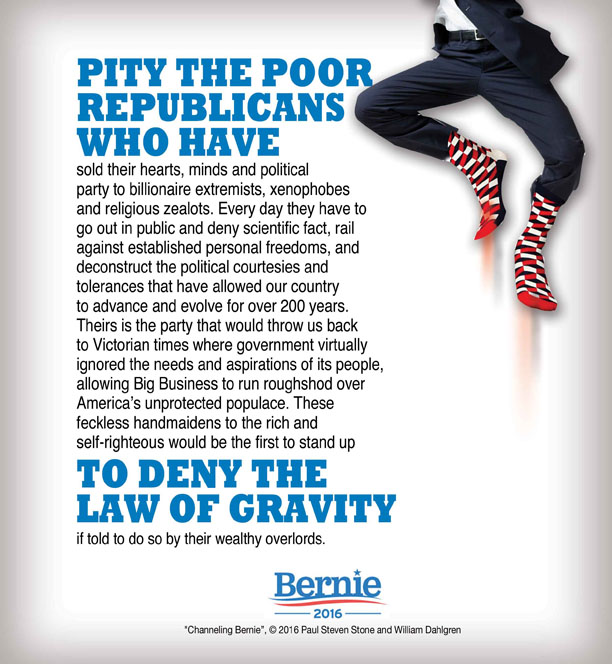
CHANNELING BERNIE: The Complete Campaign


CHANNELING BERNIE: The Complete Campaign


OUR LATEST BERNIE AD. See below for all ads in the campaign!

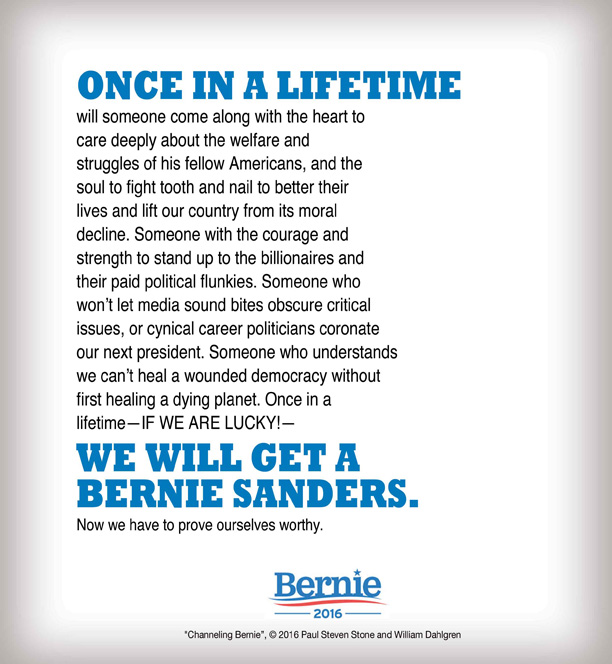
BERNIE_AD_42_SFTW


This is truly a grass roots advertising campaign. And yet it’s wholly epic in the great American tradition. Two advertising veterans creating an online campaign for Bernie Sanders’ seemingly quixotic reach for the presidency. Grass roots yes, but hopefully not half as amateurish as the email blasts most political campaigns send out. It’s been an amazing journey, creating these ads, one in which I’ve honestly felt like I’ve been channeling the candidate’s vision and perspective. Or else he’s been in my head over the years and I didn’t know it. You choose…!
BE AWARE: These ads were developed as Bernie’s campaign evolved, so some will use facts or figures from earlier in the campaign, while others have been obsolesced by the movement of events. Feel free to share any of them, but be aware I plan to upgrade ALL ads before we go into the general election.
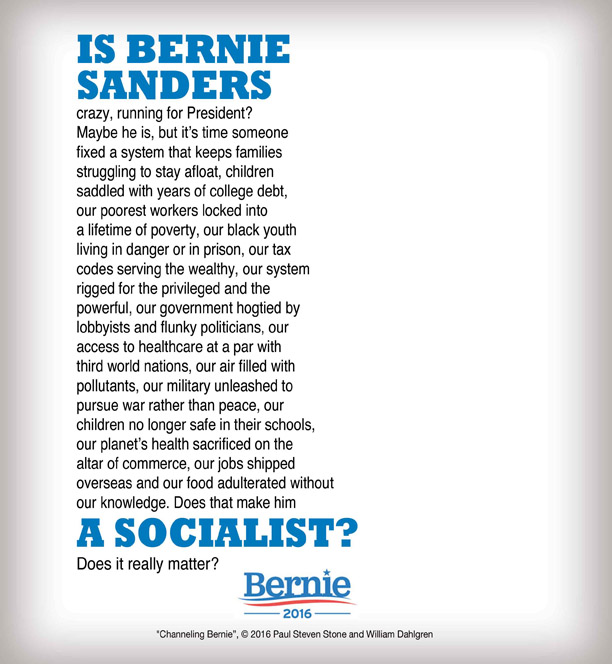
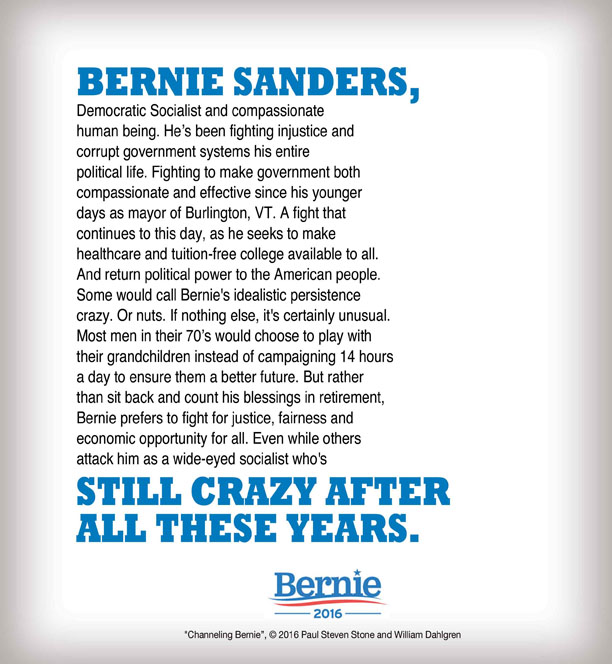
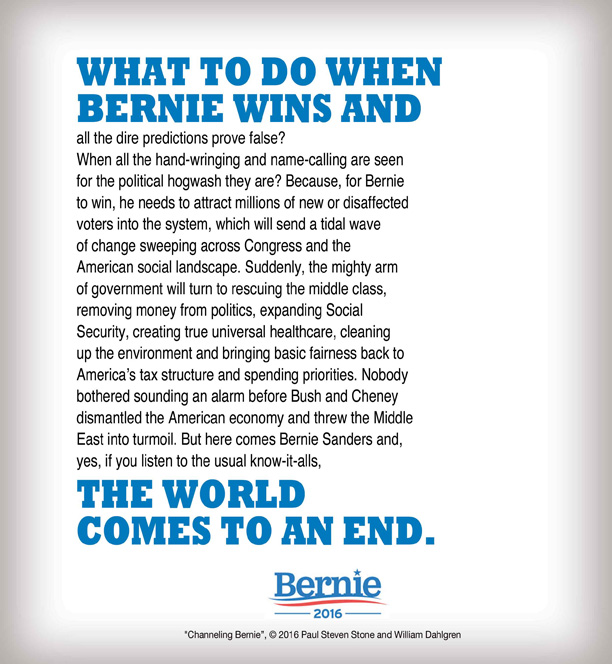
Ad #1: Developed to inoculate Bernie against attacks for being a Socialist. (see below the following text for the remainder of our CHANNELING BERNIE campaign ads.)
BERNIE_AD_1_V2_SFTW

Originally, I thought I would just work out a campaign concept that Bernie might use in his email outreach, one that offered a little more punch than the run of the mill stuff he’d been sending out. A concept, you see,  that had more intelligence and sex appeal, but was still relevant to Bernie, his campaign and his audience.
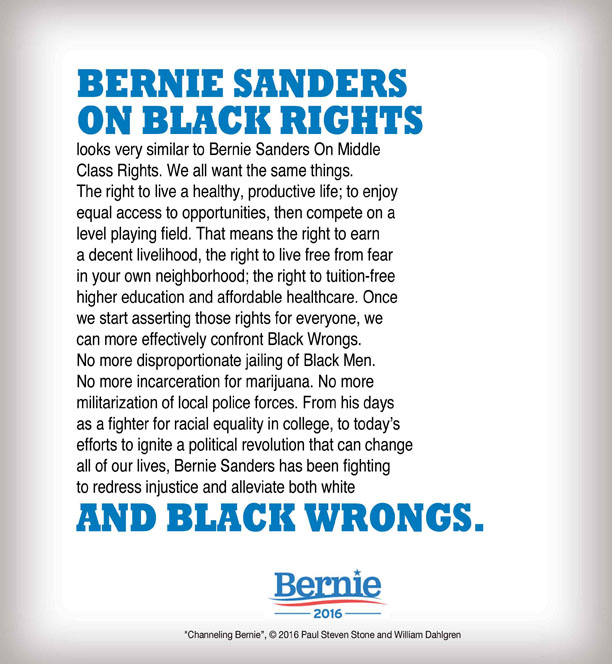
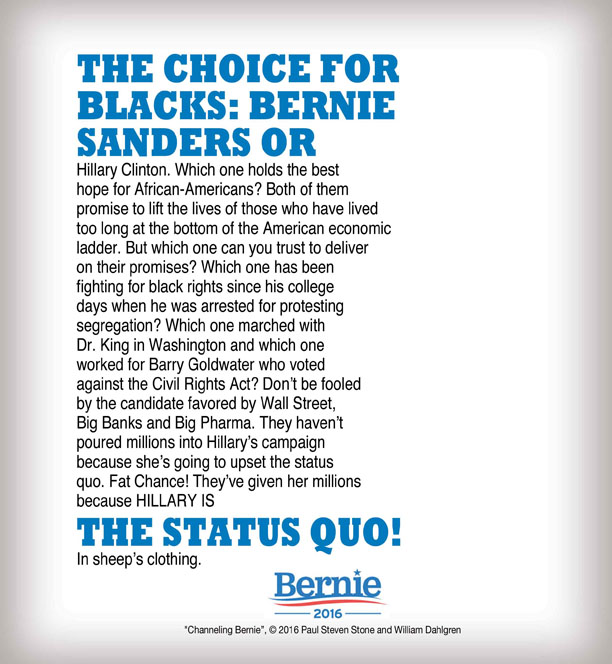
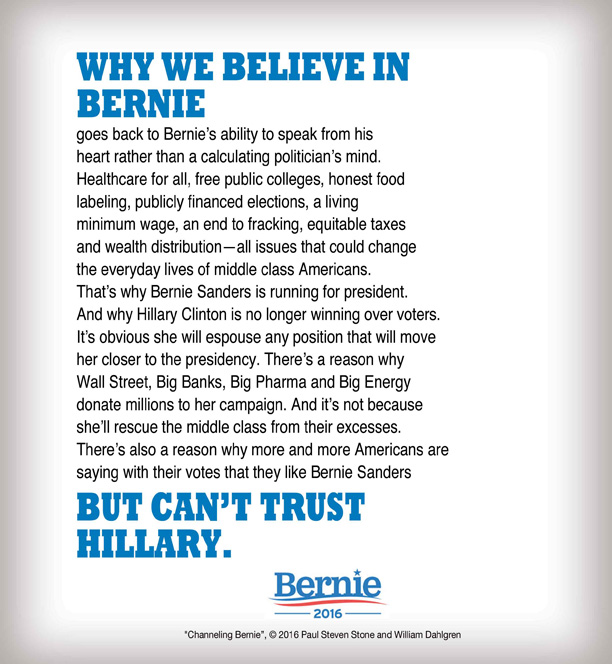
Of course once I got started, these ads/essays had a life of their own. So far, we’ve created over forty ads/essays in this first leg of the journey—Primary Season. We’ll see where—if anywhere—things go from here. At the very least, these Bernie ads/essays offer a quick look at the wrongs Bernie will set right, his specific stances on specific issues, while some offer glimpses of others in the race. Here again, all of it channeling Bernie’s positions to the best of my understanding and ability.
A short word about the format of the ads/essays. I saw an ad in a Cleo Award Show book that gave me the idea to have my headlines serve as the start and finish to an ad’s entire copy statement. I’m not sure why, but the ads are highly compelling. It could be the reader’s natural curiosity about how the author made the start and the finish of the copy fit within the narrative flow—or could there be some momentum-building effect by having the beginning of an ad suddenly leap to the ad’s conclusion? Either way, the ads/essays are uniquely readable in this format, and possibly more engaging than the usual run of political online or print ads.
And so, with art direction by Bill Dahlgren, concept and copy by Paul Steven Stone, I offer for your inspection, enjoyment and further distribution the 41—Count ‘Em!— 41 ads that make up the Primary Phase of our “Channeling Bernie” advertising campaign.
PLEASE FEEL FREE TO SHARE ANY OR ALL OF THE FOLLOWING ADS. IT WOULD BE ESPECIALLY HELPFUL IF YOU COULD POST THESE ON YOUR SOCIAL MEDIA. THANK YOU!
Ad #2: On The Issue of Gun Control
BERNIE_AD_2_V2_SFTW

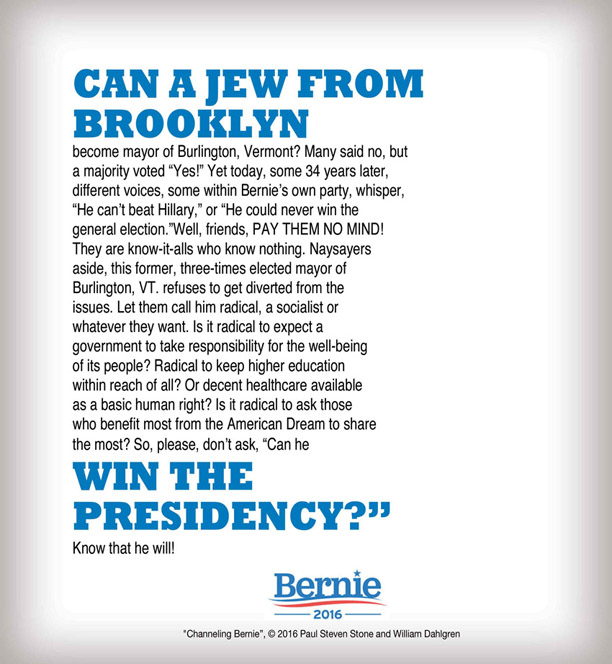
#3: Intended to inoculate Bernie from attacks for being a Jew from Brooklyn. Also focused on combating the electability issue head on.

BERNIE_AD_3_V2_SFTW


Ad #4: Donald Trump ‘tribute.’

BERNIE_AD_4_V2_SFTW


Ad #5: A ‘Love Song’ for Hillary.

BERNIE_AD_5_V2_SFTW


Ad #6: Playing with an obvious and natural branding theme for Bernie.

BERNIE_AD_6_SFTW


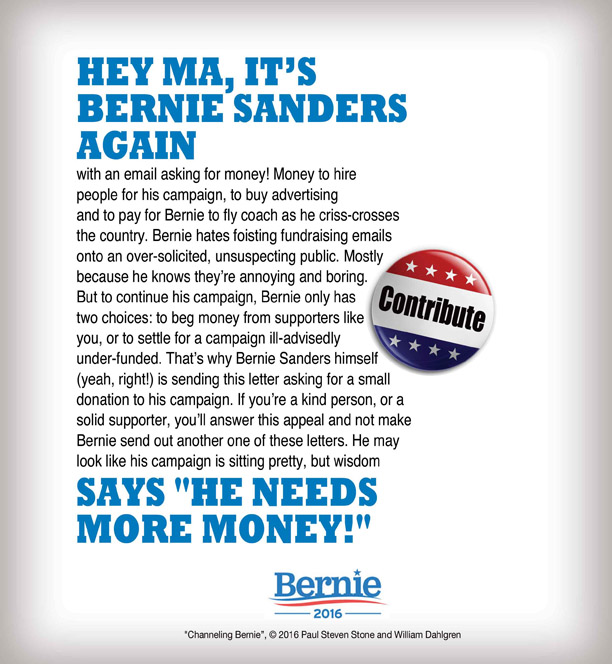
Ad #7: My idea of how the campaign might ask for money. With a little more humor and panache. “Contribute” button would hyper-link to donor page.

BERNIE_AD_7_SFTW


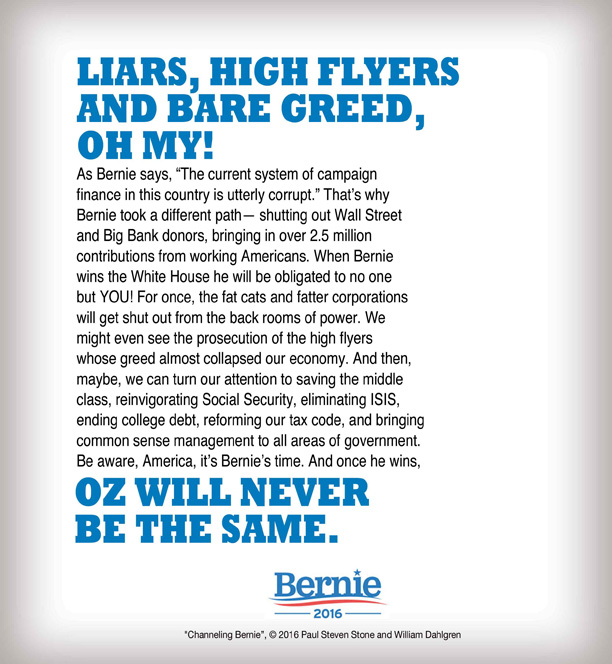
Ad #8: Slight rant about those F@%king guys who gave the American economy a wedgie of giant proportions. Most readers, I believe, got the Wizard of Oz connection to “Liars, Tigers and Bare Greed! Oh my!”

BERNIE_AD_8_SFTW


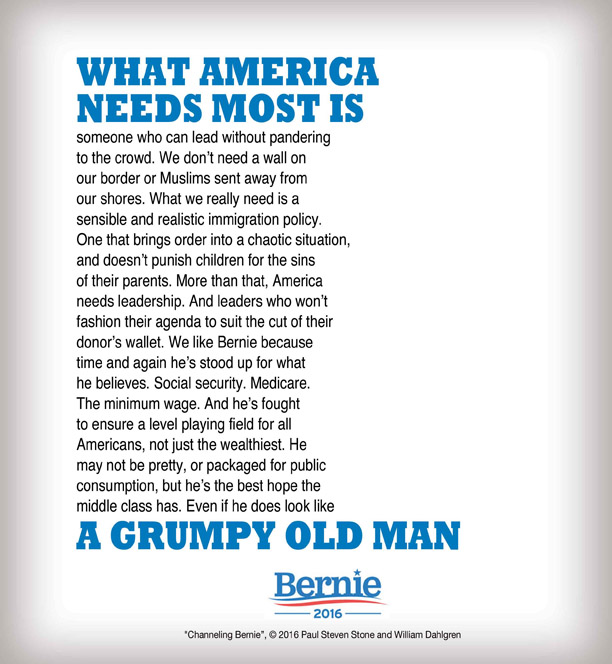
Ad #9: My second Donald Trump tribute. Also, bringing back the Grumpy Old Man.

BERNIE_AD_9_SFTW


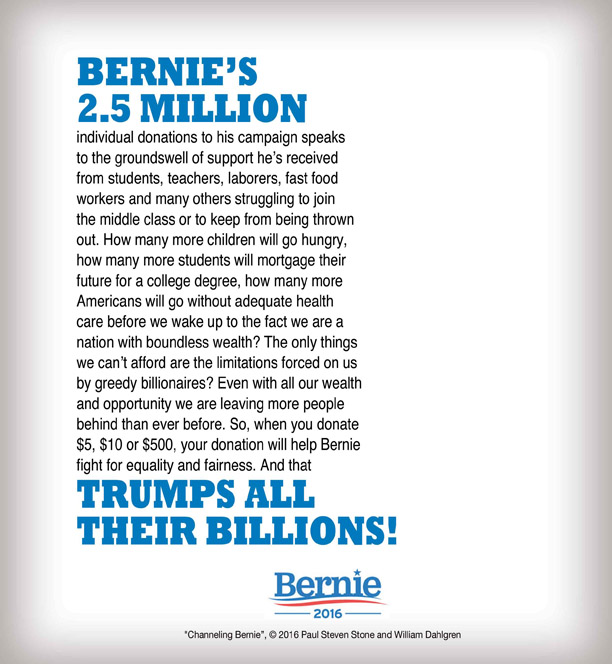
Ad #10: We are millions!

BERNIE_AD_10_SFTW


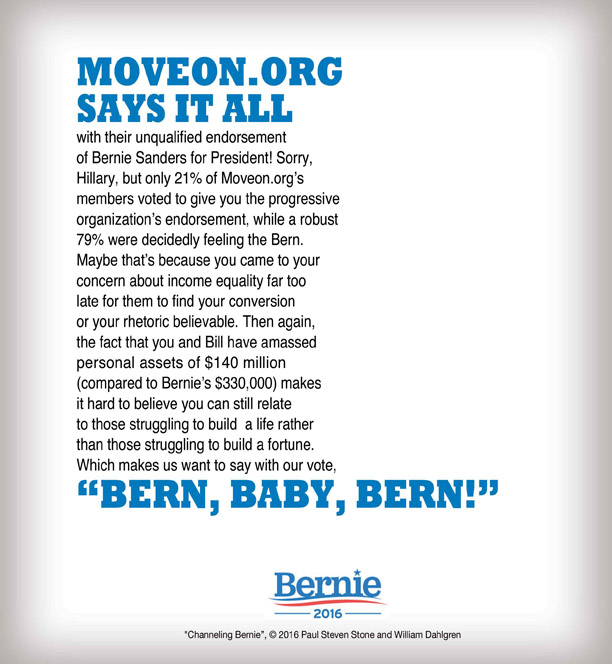
Ad #11: Moveon.org’s endorsement was a big deal, man. Real big!

BERNIE_AD_11_SFTW


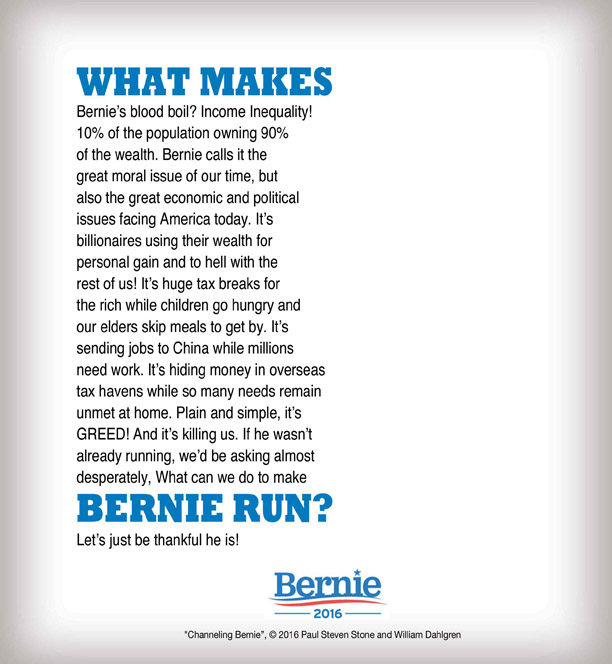
Ad #12: I always loved the book title, “What Makes Sammy Run?” A great book by Budd Schulberg. Borrowing from Mr. Schulberg seemed to suit my purpose here.

BERNIE_AD_12_SFTW


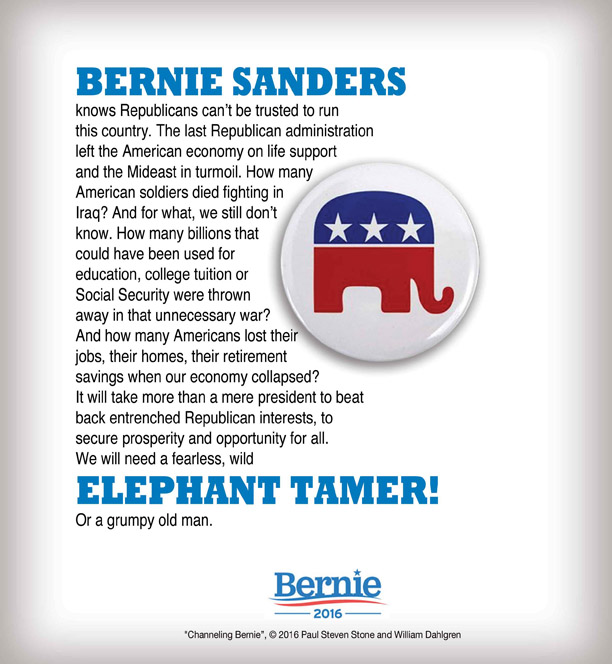
Ad #13: Lucky 13 concerns those screw-up Republicans in all their Bush-whacking glory!

BERNIE_AD_13_SFTW

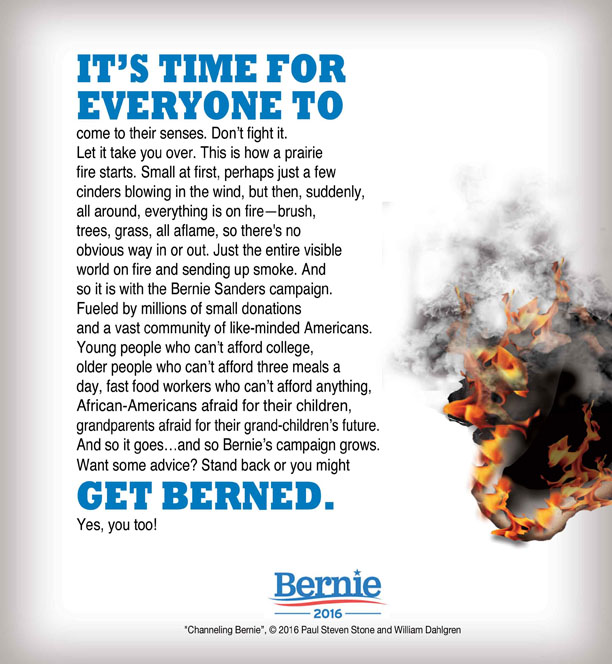
Ad #14: Are we hot or what!!

BERNIE_AD_14_SFTW


Ad #15: Bernie’s version of pro-life.

BERNIE_AD_15_SFTW


Ad #16: After seeing Bernie’s TV ad, “America” another Paul Simon song came to mind.


BERNIE_AD_16_SFTW


Ad #17: It’s the establishment’s turn to panic as they realize, “Oh my God, this guy’s for real!”


BERNIE_AD_17_SFTW


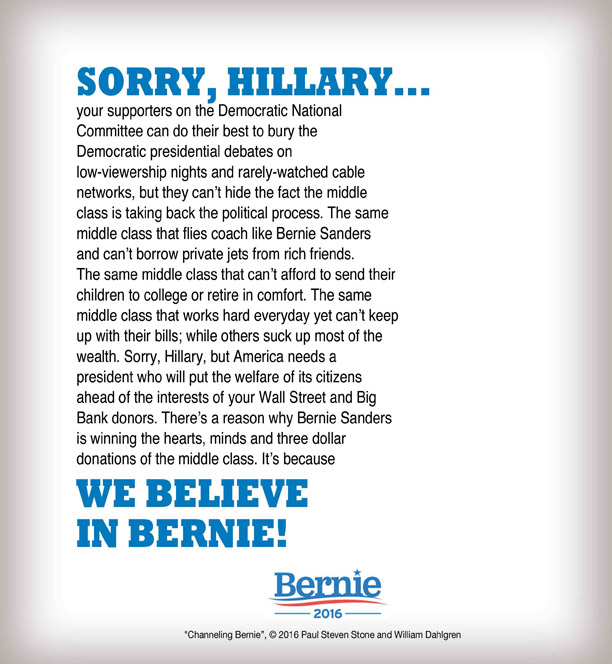
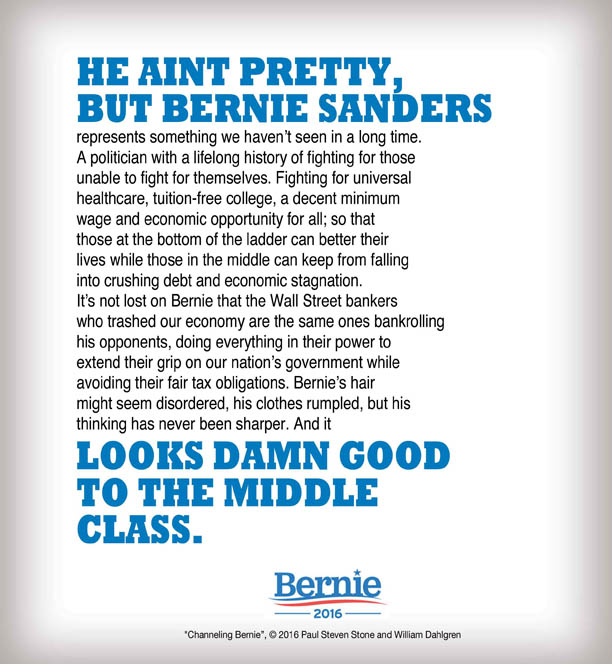
Ad #18: Wherein I speak directly to the Middle Class.


BERNIE_AD_18_SFTW


Ad #19: For those who would prefer their politics seasoned with less money and more public involvement.


BERNIE_AD_19_SFTW


Ad #20: And so we begin to break tHillary Clinton’s stranglehold on the Black Vote.

BERNIE_AD_20_SFTW


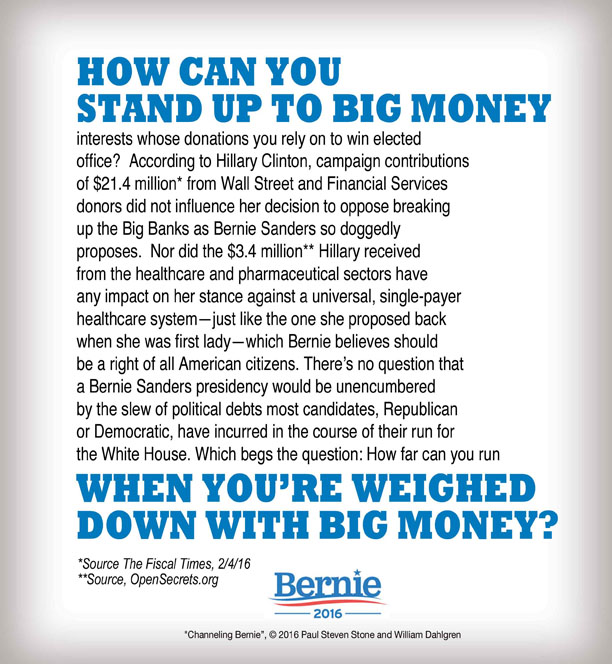
Ad #21: About those Goldman Sachs campaign donations…?

BERNIE_AD_21_SFTW


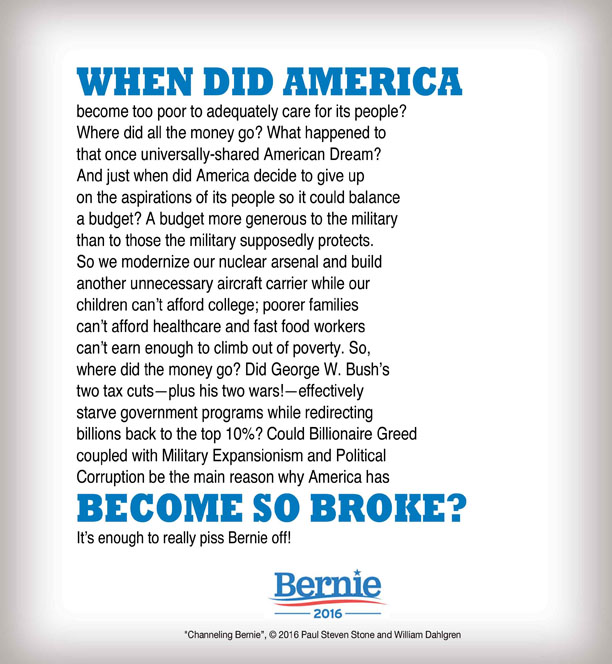
Ad #22:  Have you started to wonder about things, to ask yourself why America seems so poor. And where did all the money go?

BERNIE_AD_22_SFTW


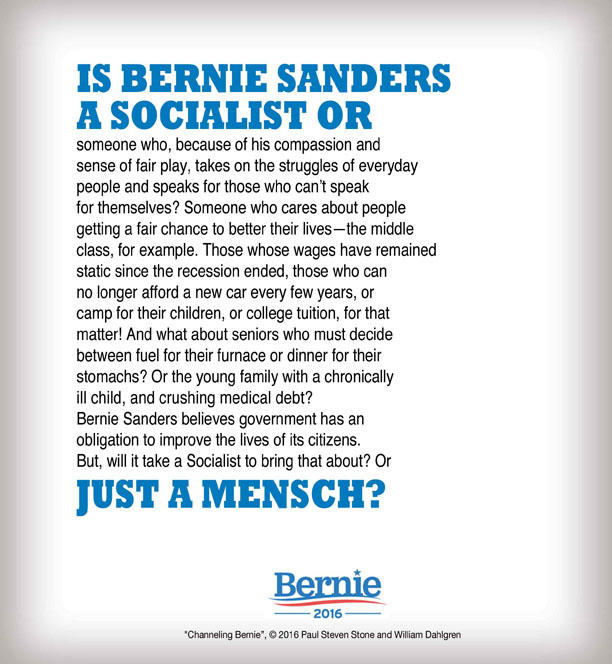
Ad #23: The man is a mensch! He sees, he cares, he acts.

BERNIE_AD_23_SFTW


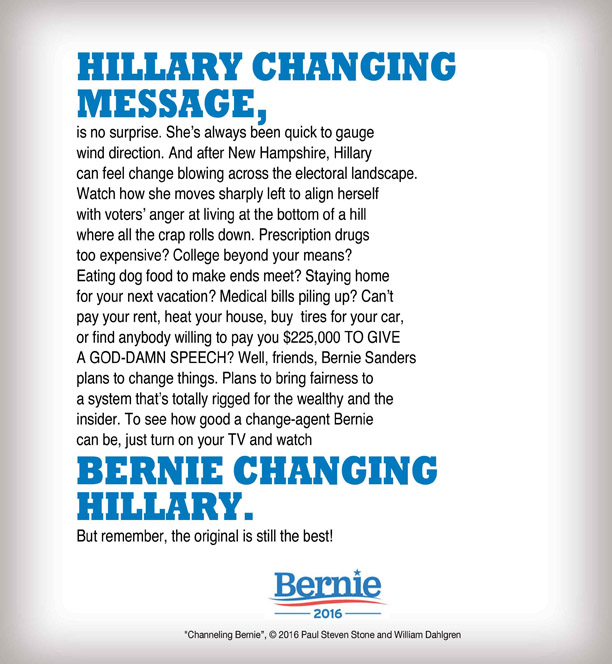
Ad #24: Anybody notice Hillary’s shift to the left during the campaign, as Bernie’s messaging gets stronger and more universally accepted?

BERNIE_AD_24_SFTW


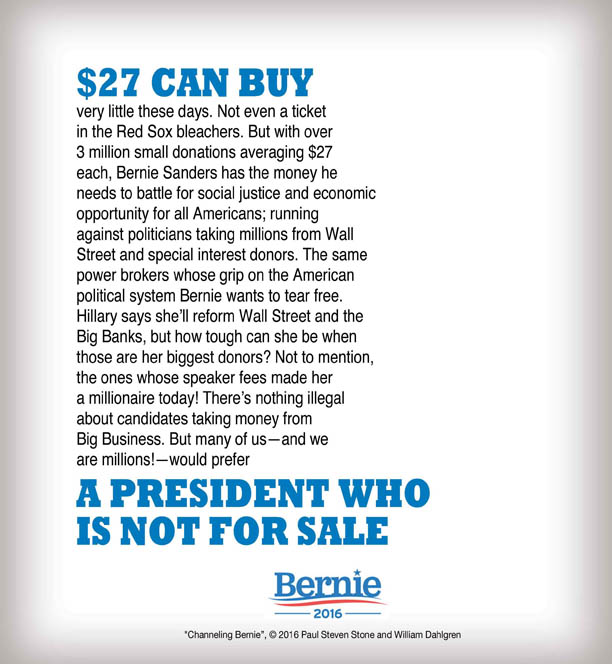
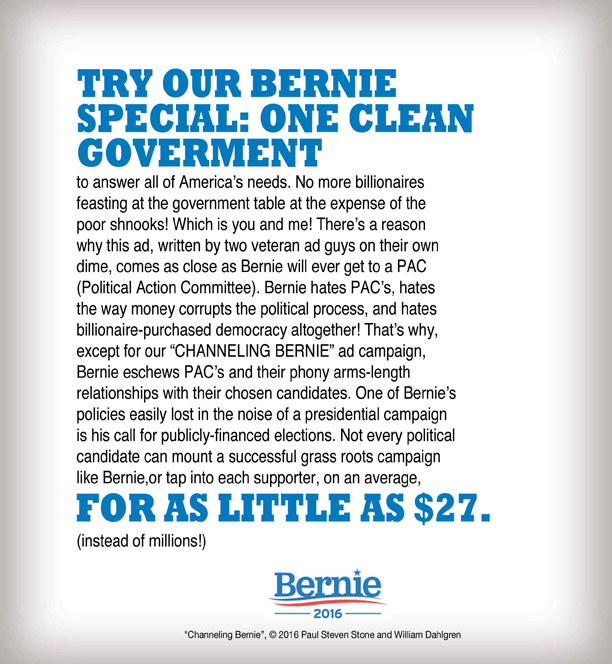
Ad #25: Doesn’t cost much to clean up government, just an average of $27!

BERNIE_AD_25_SFTW


Ad #26: The Road to the White House is festooned with obstacles, challenges and, yes, bandits. 


BERNIE_AD_26_SFTW


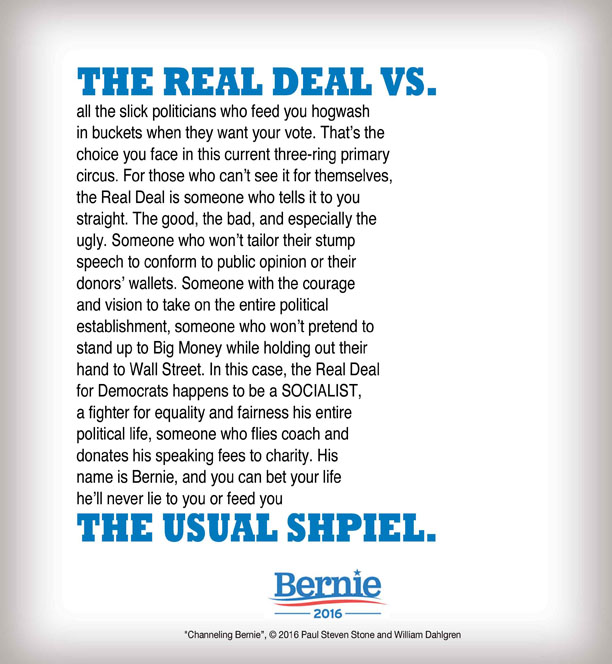
Ad #27: He’s the Real Deal, Solid Gold, A Man For All Seasons and A Real Mensch!

BERNIE_AD_27_SFTW


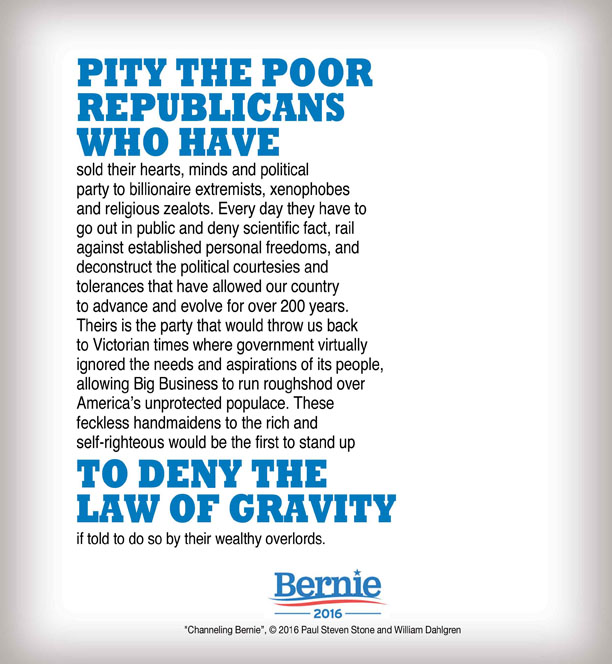
Ad #28: Let’s take a moment out to talk about our Republican “Friends”

BERNIE_AD_28_SFTW


Ad #28a: An then we had a little fun with Ad #28a.

BERNIE_AD_28a_SFTW


Ad #29: As for Brass Balls on Steroids, you can’t beat our GOP would-be-Presidents!

BERNIE_AD_29_SFTW


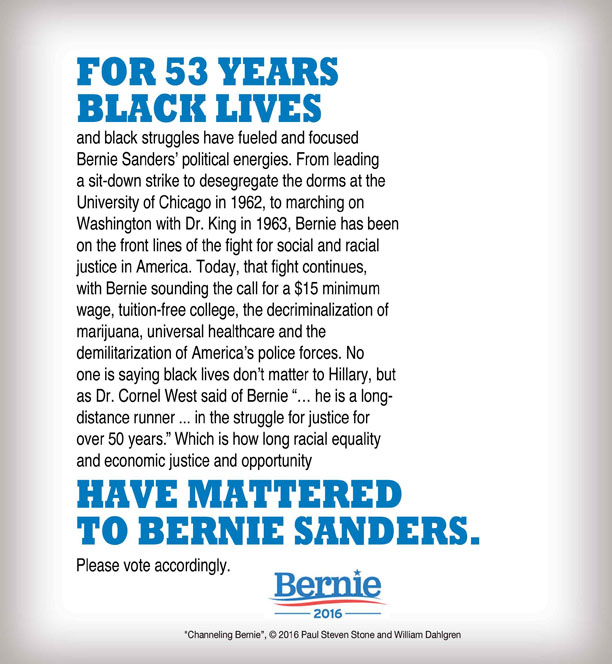
Ad #30: The Final Word; this time on Black Rights and Wrongs.

BERNIE_AD_30_SFTW


Ad #31: Hillary’s African-American support is a prime example of a population segment voting against its own best interest.

BERNIE_AD_31_SFTW


Ad #32: Bernie is the Real Deal. Over a long political career, he’s consistently supported the people over the corporations; the people over the insiders and the wealthy; the people over those who would use government to fleece the people.
BERNIE_AD_32_SFTW

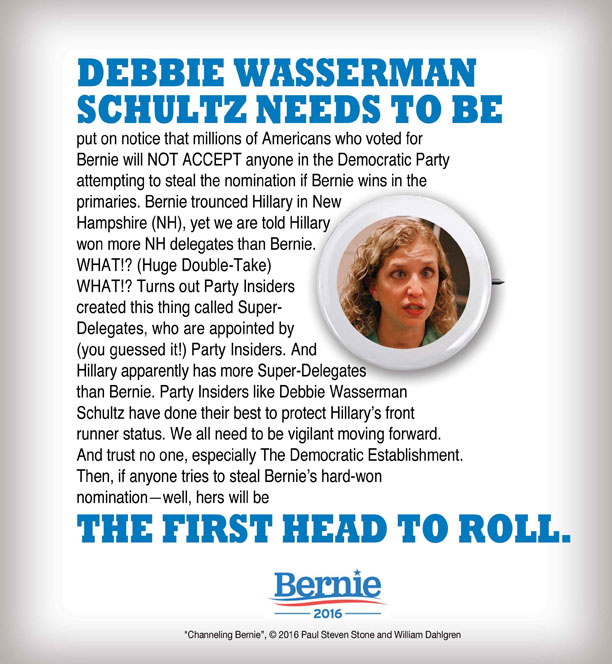
Ad #33: Evidence is mounting that Hillary and Bill are trying to steal the nomination. Time to take off the kid gloves.
BERNIE_AD_33_SFTW
Ad #34: It’s All About TRUST!
BERNIE_AD_34_SFTW

Ad #35: Oh, so Hillary doesn’t won’t debate in New York, won’t she!
BERNIE_AD_35_SFTW
Ad #36: Really folks, are you seriously considering a candidate who is the subject of an active FBI investigation? And what’s going to happen when the shit from the Panama Papers hits the fan?
BERNIE_AD_36_SFTW

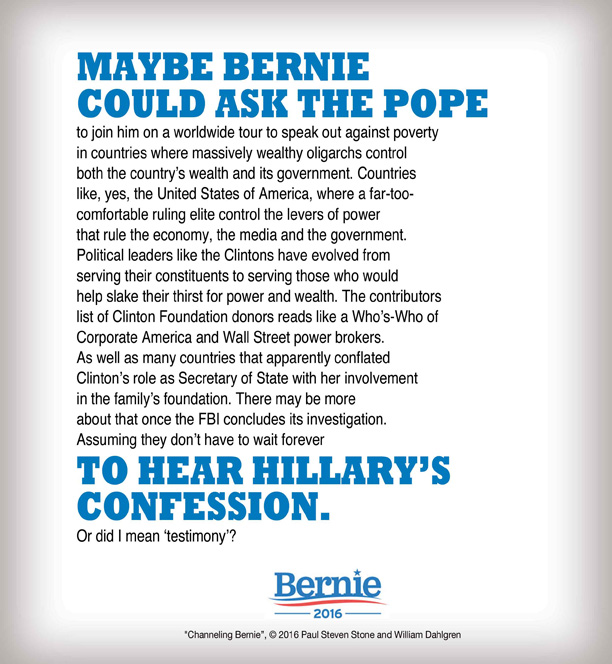
Ad #37: Bernie speaks to the Pope, Hillary testifies before the FBI. A contrast that says it all when comparing the two Democratic candidates for the presidency.

BERNIE_AD_37_SFTW


Ad #39: DON’T LET THE BASTARDS GET YOU DOWN! 

BERNIE_AD_39_SFTW


Ad #40: How did things ever get this bad? And why did it take one man to wake us up to the truth?

BERNIE_AD_40_SFTW


Ad #41: Trying to succinctly define the incredible opportunity Bernie Sanders represents.


BERNIE_AD_41_SFTW


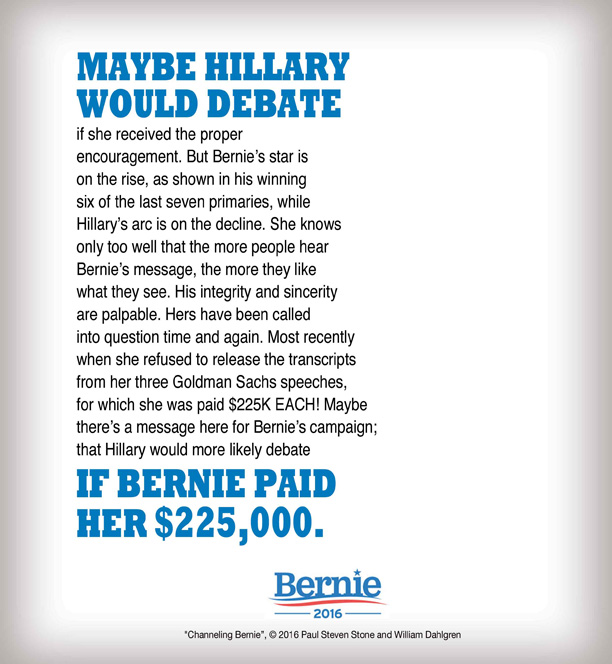
Ad #42: And now let’s pay a little attention to Hillary’s flaws. If a woman with $111 million can be said to have any flaws.

BERNIE_AD_42_SFTW


Share this:


This entry was posted in Bernie Sanders and tagged , ,, , , ,  on  by .

Saturday, May 14, 2016

THE POLITICAL REVOLUTION WILL CONTINUE LONG AFTER BERNIE SANDERS’ CAMPAIGN. HERE’S HOW.


Bernie Sanders' call for political revolution has inspired grassroots groups to continue his work even after the election is over.



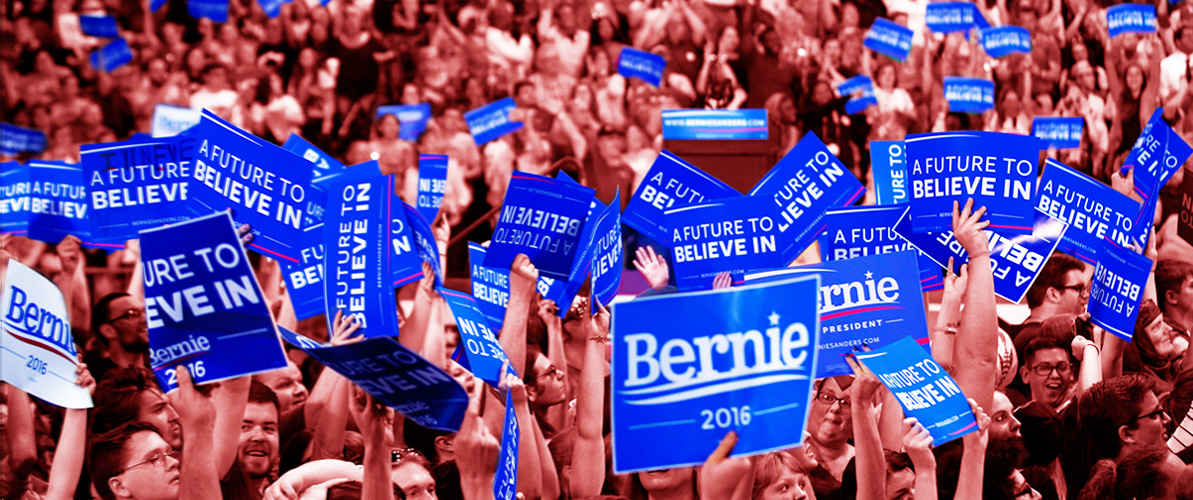
AYEAR AGO, WHEN BERNIE SANDERS ANNOUNCED HIS RUN FOR PRESIDENT, few thought his bid would amount to more than a protest campaign. But today, after more than 2 million donors and 400,000 volunteers have helped Sanders build a highly effective political organization that has earned him victories in 18 states so far, activists are strategizing about how to turn his campaign into a long-term movement.
In nearly every state in the nation, autonomous grassroots organizations began campaigning for Sanders months before his campaign established any official presence on the ground. Ranging from state-level organizations such as Illinois for Bernie and Team Bernie NY to city and even neighborhood groups, they brought together thousands of volunteers—many of whom had never participated in electoral politics—to work together toward a common goal.
Now, those organizations are beginning to build coalitions with labor, socialist parties and progressive groups to set a post-election agenda for the political revolution. To that end, National Nurses United, which endorsed Sanders, is organizing a People’s Summiton June 17 in Chicago, while the People’s Revolution, a group founded by former Occupy organizers, is hosting a People’s Convention in Philadelphia two days before the Democratic National Convention in July. As with any project to unite the Left, however, these efforts must first grapple with long-standing divides around tactics and priorities.
“The advantage of a presidential campaign is that it unifies competing interests around a common goal,” says Charles Lenchner, cofounder with Winnie Wong of People for Bernie, one of the largest pro-Sanders grassroots organizations and a partner in the People’s Summit. “Without a candidate to rally around, the contradictions become more visible.”
One of the biggest open questions is what role Sanders and his campaign infrastructure will play. On a number of occasions, Sanders has expressed his desire to continue fighting for political revolution, win or lose. Larry Cohen, former CWA president and senior adviser to the Sanders campaign, says that Sanders will continue to be a “transformational force” in American politics well beyond the election. The Sanders campaign recently began fundraising for three progressive insurgents who are challenging Democratic incumbents: Zephyr Teachout in New York, Lucy Flores in Nevada and Pramila Jayapal in Washington. The campaign also plans to support other down-ballot candidates, according to Cohen.
Cohen thinks that Sanders will also support grassroots efforts to further his political revolution. “His own support for it won’t be centralized, but more of a facilitating role within that network,” says Cohen. “That is a characteristic of how this campaign has operated from the start, and that’s not an accident.”
“We want Bernie to share what he built in large part thanks to our help. We want to make sure it goes back to the people.”
The People’s Revolution envisions “Bernie without the Bernie,” says Jack “Jackrabbit” Pollack, who in October cofounded the group with fellow Sanders organizer Shana East. “What Bernie has shown us is that you can actually rally people around a set of policies that are really all going in a positive direction.”
The People’s Revolution sees Sanders as a critical partner in building a broad issues-based progressive movement to ensure the promise of the campaign—“A Future to Believe In”—becomes a reality. At the People’s Convention, the group plans to develop and ratify a People’s Platform to present to the Democratic National Convention and set an agenda for the broader movement.
The People’s Revolution also hopes to convince Sanders to turn over the resources his campaign has amassed—money, voter data and an email database—to the grassroots. “We want Bernie to share what he built in large part thanks to our help,” Pollack says. “We want to make sure it goes back to the people.”
To that end, an unrelated group of more than 1,000 Sanders supporters recently signed an open letter, drafted by New York teacher and labor activist Erik Forman, calling on Sanders to devote his resources toward building a permanent organization.
While he declined to go into specifics, Cohen says these questions are on Sanders’ mind as well. “There’s been a recognition by Bernie that this is about supporters feeling like they own a chunk of this campaign. That’s what accounts for the number of donations, and more importantly the number of volunteer hours.”
But Charles Lenchner cautions against relying on the Sanders campaign for direction and support. “The lesson of People for Bernie has been that you don’t need those traditional gatekeepers to make a difference,” he says. “The early weakness of the Sanders campaign was its greatest strength. People had to figure out how to build the infrastructure of a political campaign by themselves. We were able to create a massive volunteer network with almost no money at all. We want to make it as difficult as possible for outside groups to co-opt the movement that’s united behind Bernie.”
Another obstacle, of course, is that not everyone on the Left is united behind Sanders. Critics from the movement for Black lives have argued that Sanders’ focus on economic issues fails to confront the racialized nature of American capitalism.
“For too long, economic justice movements have asked people from marginalized communities to bracket their identities for the sake of the cause,” says Jessica Pierce, national co-chair of the Black Youth Project 100 (BYP100). “It’s one thing to say, ‘This is the people’s movement,’ but who are those people and how are they coming together?” Pierce continues. “Inclusion has to be completely integrated into your organizational structure. If I’m not seeing anything in a platform that speaks to what I deal with every day as a Black person, then that’s telling me I don’t matter.”
Pierce says BYP100 has not yet been contacted by organizers of the Summit or the People’s Convention (both groups say they plan to reach out). Pierce sees strategic potential in such large-scale collaborations, but for BYP100, she says, the key question would be, “How does it help us advance our cause, too?”
Lenchner believes that addressing concerns like Pierce’s is vital to creating a sustainable long-term movement. “We need to be intentional about bringing new people into leadership positions in the movement,” he says. “One of the big challenges is that movements tend to be led by the first people who showed up. That’s not a good way to decide who leaders are. It also shouldn’t just be the people who can work the most, because they’re the ones who have enough privilege to be able to do so.”
Lenchner hopes to address such questions head-on at the People’s Summit in Chicago, as well as moving beyond the “silos” that progressives often work in. Democratic Socialists of America is joining People for Bernie and NNU in organizing the event, and they’ve brought in a diverse array of groups such as Progressive Democrats of America, People’s Action, United Students Against Sweatshops and 350.org.
The goal is to “use the opportunity of a political campaign to generate broad unity on the Left, while creating a space for people to act autonomously to pursue their own goals and interests,” Lenchner says.
“The lesson of People for Bernie has been that you don’t need those traditional gatekeepers to make a difference.”
One point of tension is the age-old question of whether to continue to engage in electoral politics. “For many of us, participation in electoral politics feels like an abusive relationship,” reads Erik Forman’s open letter to Sanders. “Many of us poured our hearts into the presidential bids of the Rainbow Coalition, or the long-shot campaigns of Ralph Nader and other Green Party candidates. Many of us turned out to put Obama in the White House. … All of these electoral campaigns left little behind but broken hearts.”
Pollack, however, argues that the Sanders campaign has shown that the Left can actually win elections and use them to build power. “My experience with the Left has been that we reject electoral politics, and we agitate and we lobby,” he says. “But today Bernie is illustrating the idea that an electoral insurgency can take place that can actually push our agenda forward.”
The People’s Revolution hopes to spark similar insurgencies in future races on every level of the political system. Toward that end, they are talking with Grassroots Select, a digital collective founded by Sanders supporters to channel resources and volunteers to candidates who share Sanders’ agenda. Pollack also points to Berniecrats.net, a crowdsourced list of more than 250 pro-Bernie candidates running in 2016, as another example of how Sanders’ grassroots support can buoy other progressive candidates.
Differences on strategy aside, however, Pollack thinks the most important goal is ensuring that the political revolution promised by the Sanders campaign doesn’t fade away. “People who didn’t believe they had anything to fight for suddenly realized that they weren’t alone,” he says. “We need to organize, we need to strategize and build power to make our ideas a reality.” 
This is the first in a new series on the political revolution sparked by the Bernie Sanders campaign, and the impact it's having beyond the election.

Friday, May 13, 2016

Doctors Agree With Sanders on Universal Health Care


Home


ELECTION 2016
Physicans warn that the risks of continuing the ACA will leave millions uninsured indefinitely.
AddThis Sharing Button
Photo Credit: Phil Roeder/Flickr CC


Presidential hopefuls have their own ideas on what to do with the Affordable Care Act (ACA), President Obama’s signature legislation, when they move into the White House.

Sen. Bernie Sanders thinks it should be replaced with a single-payer health plan of the kind Europe and Canada have. This federally administered universal health care program would eliminate copays and deductibles. There’s currently a move afoot in Colorado to have such a plan.

Secretary Hillary Clinton would like to keep the ACA, with a few fixes.

Donald Trump says he will uproot the ACA, get Congress to allow the sale of health insurance across state lines and allow individuals to take tax deductions for insurance premium payments. But that would not help low-income Americans because they do not pay much in income taxes.

This week, the American Journal of Public Health carried a proposal by a working group of more than 2,000 physicians nationwide titled: Moving Forward from the Affordable Care Act to a Single-Payer system. The physicans warn that the risks of continuing the ACA will leave millions uninsured indefinitely.

NAM health editor Viji Sundaram interviewed Dr. Adam Gaffney, a co-chair of the working group.

Viji Sundaram: Your proposal calls for a single-payer health care plan for the United States. Obamacare has helped 16.9 million people become newly insured. Would it not be less disruptive to expand the provisions in the ACA instead of repealing the law and replacing it?

Dr. Adam Gaffney: The U.S. health system is highly disruptive as things stand now. You’re liable to lose your insurance at any time—for instance, if you change your job or get divorced. Similarly, those purchasing plans on the “marketplaces” may find that they can keep down premium increases by changing plans on an annual basis. Every time your insurance plan changes, you may need to change all of your doctors and hospitals in order to stay “in network.” This is enormously disruptive to people’s health care. In contrast, in a single-payer system, everyone has free choice of doctors and hospitals.
VS: Your proposal promises health coverage for all. Does this include undocumented U.S. residents?

AG: Yes, it would. The single-payer national health program we envision would include everyone regardless of country of origin, including undocumented residents. If we believe that health care is truly a human right, then this is the right thing to do. At the same time, it is also financially achievable. Immigrants, on average, have lower health care spending as compared to those born in the United States. One study demonstrated that immigrants actually pay more into Medicare than what they use in terms of health care. Everyone would be included in the national health program we envision.

VS: Why do you think there would be no additional government spending if the United States has a single-payer health care plan? Countries such as Canada and the England run their national health program on the backs of taxpayers. Will that happen in the United States as well? Can it be done without raising taxes?

AG: There would be additional government spending with a single-payer plan, but this would be offset by the elimination of spending by individuals and employers on premiums, co-payments, and deductibles. We can expand coverage to everyone in the country and eliminate co-payments and deductibles, and at the same time keep overall current health care spending roughly unchanged.

VS: Some providers criticize single-payer plan as one that will force them to contract with the one payer available. Currently, providers have some choice of insurers. They can even opt out of Medicare and Medicaid.

AG: There are many benefits for practices to have to contract with only one payer: it’s much simpler and is less costly from an administrative perspective.

VS: How would you respond to the criticism of the single payer program as having the capacity to get doctors to sign in with fairly attractive reimbursement rates, but once in, those rates can come down, leaving providers helpless?

AG: Because the vast majority of the nation’s doctors would participate in the national health program, there would be a powerful lobby fighting to ensure that reimbursements remain fair.

VS: In countries that have a single-payer health care system, there seems to be a long waiting period before a patient can see a doctor. How can we keep that from happening in this country?

AG: The problem of waiting times for care in other nations is often exaggerated. Moreover, where there are excessive waiting times for elective procedures, it is often due to underinvestment. We spend much more than other countries on health care, and have the resources to ensure that waiting times for elective procedures are reasonable. It’s also worth noting that we have waiting times in the United States also, though they are not as visible. Indeed, if you have the wrong insurance plan [currently], the waiting time for some providers may, so to speak, be infinite.

VS: The UK allows people to be in both the national health plan as well as subscribe to a private insurance plan, which they can fall back on for expedited care. But your plan calls for an end to commercial insurance.

AG: First, if providers must bill and contend with multiple different insurance plans, we lose the efficiency savings that come with a single universal system. Second, if we give the rich preferential access to superior and expedited care while relegating everyone else to an inferior tier, we make a mockery of the idea of an equal right to health care. Third, the best way to ensure that the quality of health care is superb is having everybody—whether rich or poor—in the same system together.

VS: Medicaid and Medicare depend on the cost shift from private payers. Some providers say the only way doctors are willing to get into the Medicare network is because they get higher payment from commercial insurers.

AG: Doctors would continue to do well under a Medicare-for-All system. The transition to a single-payer system would eliminate the need to bill and contend with a multiplicity of payers, producing substantial savings for practices (and hospitals).

VS: How much could the United States save by switching to a single-payer health plan? What does it currently spend?

AG: It is estimated that upwards of $400 billion a year could be saved from reduced spending on administration and billing that would occur through the transition to a single-payer plan. Additional money could be saved when the national health program enters into direct negotiations with pharmaceutical companies over drug prices. These savings could then be used to cover everybody in the country, while at the same time eliminating copayments and deductibles. Overall health care spending, at the end of the day, would be approximately the same as it is now, but nobody would ever again have to worry about losing insurance, about paying a big deductible if they got sick, or about not having access to the doctor or hospital of their choose. 

Viji Sundaram is the Health Editor for New America Media. Before joining NAM in 2006 Viji was a general assignment reporter with India-West, a national weekly published in San Leandro, CA. While there, Viji won eight journalism awards, five from the South Asian Journalism Association and three from New California Media.

Wednesday, May 4, 2016

After Indiana Win Sanders Declares: 'I Say We Keep Fighting. Are You with Me?'


Home


Published on
by

After Indiana Win Sanders Declares: 'I Say We Keep Fighting. Are You with Me?'


"The political and financial establishment of this country have been vocal in their desire for us to go away. To get in line. Today, the voters had another idea."


Democratic presidential candidate, Sen. Bernie Sanders, I-Vt. acknowledges his supporters on arrival at a campaign rally, Tuesday, March 8, 2016, in Miami. (Photo: AP/Alan Diaz)

Proving that U.S. voters are still energized to go to the polls to voice their support for "political revolution," Bernie Sanders won the Indiana primary on Tuesday night – besting rival Hillary Clinton and notching a much-needed victory as the corporate media and political class continues to discount his chances and downplay the accomplishments of the campaign.

"The political revolution wins in Indiana!" the Sanders campaign tweeted just after 9 PM eastern.

The Guardian described it as a "shock victory," reporting:
Despite trailing by an average of seven points in opinion polls and losing a string of bigger, more diverse states on the east coast, Sanders once again proved his appeal to disaffected midwest voters by pulling off his 18th victory of 2016, according to Associated Press projections.
Sanders seemed on track to win a narrow majority of the 83 delegates on offer. With over 80% reporting, Sanders had 52.9% of the vote to Clinton’s 47.1%.
Sanders told the Associated Press: “The Clinton campaign thinks this campaign is over. They’re wrong.”

In an email sent to supporters just before 10 PM eastern, Sanders said the victory in Indiana helps prove his recent argument that every voter in the country deserves to be heard this primary season.

"For the past several weeks, the corporate media has counted us out of this election," Sanders wrote. "The political and financial establishment of this country have been vocal in their desire for us to go away. To get in line."

But in Indiana on Tuesday, Sanders added, "the voters had another idea."

Despite recent losses, Sanders has repeatedly said he intends to take his campaign through to California, among the very last primaries of the season as well as the most populous and delegate-rich state in the country.

"Every victory we earn is extraordinarily important for our political revolution," he continued. "Not just because of the delegates we earn, but because each win and all the work that goes into that effort sends an unmistakable message to the establishment of this country that we will never stop fighting for the values we share. I say we keep fighting. Are you with me?"

Monday, May 2, 2016

Feeling the Bern!


https://theindependentthinker2016.wordpress.com/


cult
Those of us who are moved by Bernie Sanders are often disparaged for our passion.
Critics say
“You’re really drinking the Sanders Kool-aid.”
or
“You Bernie-Bots (insert hateful remark here).”
We laugh it off.
We get things back on track by talking about issues.
We are like our leader in that way.
cult2
What we never do is acknowledge that maybe there is some truth to the claim that we are, in many ways, cult-like.
Many of us are atheist/agnostic, so the mere mention of organized religion strikes us with great offense.
How could we have rejected the old culture so severely, only to end up being in some way similar?
How can we stretch towards enlightenment, if we are mired in the flawed ways of our ancestors?
cult3
The critics are right.
We are, in some ways, cult-like.
But they are also wrong.
We are not Bernie-Bots, for if anything, we are the opposite of automatons.
Bernie Sanders followers may be loyal, but do not do yourself the disservice of thinking that we are in any way robotic.
In fact, one of the key components of the Sanders campaign is the incredibly creative ways in which his followers solve problems and create promotional materials.
roof
Rarely has a leader inspired so many to create art in the way that Sanders has.
Rarely have so many people used technology so creatively.
These “robots” used social media to take a man who was literally speaking in back yards a year ago and elevate him to the clear front-runner for President of the United States (this would be assuming that we actually had a true democracy, which of course we don’t…more on this at another time).
So Bernie-BOT is not an apt title.
I get what you’re trying to say…
That we are simply waiting for our master’s next word and we all act in unison, and there is some of that, to be sure, but we are a creative lot, so perhaps we could find a more appropriate moniker.
I can’t come up with one right now, but I am sure millions of creative Sanders’ supporters are creating them as we speak.
cult5

As for the Kool-Aid…
We are definitely drinking it…by the gallon…
We are definitely “drinking the Bernie Sanders Kool-Aid.”
But only after we tested it extensively.
We found out that it was honest and pure, cost $27 a pac and contained none of the Monsanto GMOs found in the leading brand, so yeah, we are REALLY excited about the Kool-Aid.
It comes in blue, red and purple and a new color may be coming soon, depending on what the Super-delegates decide to do.
The critics are so right about how much we love the Bernie Sanders Kool-Aid, that Kool-Aid should actually produce a Bernie Sanders flavor.
Where the critics fall short is that they call us a cult.
Let’s be clear, there are far too many of us to be considered a cult.
We are technically a religion.
cult7
We are actually more than a religion.
We are what religion was supposed to be.
We practice faith and good works.
We put compassion to our fellow humans above all else.
We toil for free to build strength of character and to further a cause.
We are an all inclusive religion, that does not discriminate against other religions.
We are what religion once aspired to.
religion
Another mistake the critics make is when they think that this movement is about Bernie Sanders.
This precedes Bernie Sanders and will survive him.
This movement is actually the movement that emboldened Sanders himself to stand up for civil rights before anyone knew who he was.
This movement is what helped him find the courage to stand up to those in power, when the only power he had was his voice and the willingness to sacrifice his body for the greater good.
arrested
Bernie isn’t our god…
He is our spokesperson.
He is our leader.
And as much as we hate the terminology, he is also a prophet.
Buddha does not mean God.
It means one who has attained wisdom through purely human means.
It means enlightened one.
Brother Bernie is enlightened.
hug2
Bernie Sanders will pass during most of our lifetimes.
A day will come when the entire world will mourn the passing of this great man.
What will never pass is the desire to be kind and compassionate.
The dual desires of freedom and self-actualization will forever be present.
The desire to take food from our plate and give it to our starving neighbor will not be crushed in this lifetime or any other.
We are a billion points of light, penetrating the darkness.
We are not robots.
We are thinking, feeling human beings from every corner of the globe.
And this is not a cult.
This is a religion.
One that has existed as long as humanity.
This is Humanism.